

Cat 6 vs Cat 7 Speed and Performance Guide
Introduction
In today’s fast-moving industrial and commercial world, network speed and reliability are critical to success. This Cat 6 vs Cat 7 Speed and Performance Guide provides a clear, step-by-step comparison to help you make the best decision.
Ghtcable is a professional cable manufacturer with over 15 years of experience. We specialize in high-quality Ethernet cables for global B2B clients. Our factory produces certified products under ISO9001, CE/CPR, and RoHS standards, focusing on consistent quality, competitive pricing, and reliable performance for industrial and commercial projects.
Core Speed Specifications
Frequency forms the foundation of cable performance. Cat 6 reaches a maximum of 250 MHz. Cat 7 supports up to 600 MHz.
Higher frequency brings clear advantages. Cat 7 can transmit more data at once and reduces latency more effectively.
Both cables support 10 Gbps speeds. The real difference appears with distance. Cat 6 maintains 10 Gbps only up to about 55 meters. Cat 7 keeps full 10 Gbps performance over the complete 100 meters.
This distance advantage helps large facilities avoid extra switches or repeaters. It reduces system complexity and lowers long-term costs. For warehouses, production lines, or campus networks, Cat 7 often enables simpler and more efficient designs.
Quick Performance Comparison
|
Feature |
Cat 6 Ethernet |
Cat 7 Ethernet |
|
Max Bandwidth |
250 MHz |
600 MHz |
|
Max Speed |
1 Gbps (10 Gbps @ 55m) |
10 Gbps (Full 100m) |
|
Shielding |
Usually UTP |
S/FTP (Fully Shielded) |
|
Typical Lifespan |
~10 years |
15+ years |
Shielding Impact on Real-World Performance
Shielding is often the most important difference in industrial environments:
- Cat 6 (UTP): Unshielded design works well in low-interference office and residential settings.
- Cat 7 (S/FTP): Each twisted pair has individual foil shielding plus an overall braid shield. This dramatically reduces electromagnetic interference (EMI), alien crosstalk, and RFI.
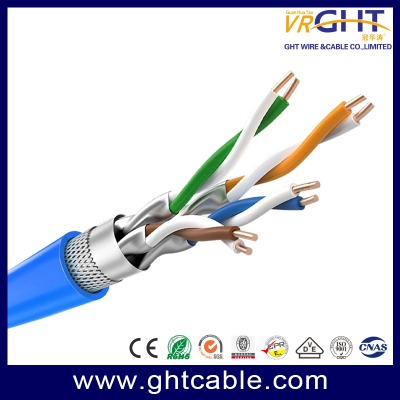
Result: In factories, warehouses, near heavy machinery, motors, or power lines, Cat 7 maintains stable signal quality with fewer packet errors and retransmissions. Cat 6 often suffers noticeable performance degradation in noisy environments.
Ghtcable rigorously tests every Cat 7 cable for harsh industrial conditions, ensuring reliable performance in real manufacturing plants and large commercial facilities worldwide.
Connectors, Installation and Long-Term Performance
Connector choice affects both ease of use and final results. Cat 6 relies on standard RJ45 connectors, offering wide compatibility with almost all routers, switches, and network cards.
Cat 7 was originally designed for GG45 or TERA connectors to reach its full 600 MHz potential. Most commercial Cat 7 cables now use high-quality shielded RJ45 connectors. They are fully backward compatible, but overall network speed always depends on the weakest link.
Installation also influences real performance. Cat 6 is light and flexible, making it easy and fast to pull and terminate. Cat 7 is thicker and stiffer due to its multiple shielding layers. It requires larger bending radius, more installation space, and proper grounding. Incorrect grounding can create new interference.
Although Cat 7 has higher material costs, a well-installed Cat 7 system delivers more stable speeds over many years. Ghtcable provides professional guidance and technical support to ensure every project achieves optimal performance.
Best Applications for Maximum Performance
Every project has different requirements. Cat 6 performs excellently in standard office buildings, short-distance 10 Gbps links, residential smart home wiring, and budget projects with minimal interference.
Cat 7 excels in demanding environments. It is ideal for industrial automation floors with heavy machinery, data centers requiring reliable long-distance 10 Gbps, and high-interference or mission-critical locations such as hospitals, airports, and smart factories.
Many clients choose Cat 6a as a balanced middle option. It offers 500 MHz bandwidth and full 10 Gbps over 100 meters with better shielding than standard Cat 6. Ghtcable manufactures the complete range of Cat 6, Cat 6a, and Cat 7 cables. We help customers select the most suitable solution based on their exact needs, site conditions, and budget.
Future-Proofing Speed and Performance
Network requirements continue to grow rapidly. IoT devices, AI systems, 4K and 8K video streaming, cloud computing, and the wider adoption of 10 Gbps are driving this change. What seems sufficient today may quickly become a bottleneck tomorrow.
Cat 6 meets current needs in many standard cases. Cat 7 provides extra headroom for future growth. It helps companies avoid expensive rewiring projects in the coming decade and keeps infrastructure ready for higher speeds and new technologies.
As a direct factory supplier, Ghtcable supports long-term planning with stable quality, flexible customization, and competitive pricing for bulk orders. Our global clients trust us for certified, high-performance network cabling solutions that deliver consistent results over time.
Conclusion
The Cat 6 vs Cat 7 comparison shows clear strengths for each cable type. Cat 6 offers great value and easy installation for everyday applications. Cat 7 delivers superior speed consistency, distance capability, and interference protection in professional and industrial settings.
Review your site conditions carefully. Consider distance requirements, interference levels, and future growth plans. For high-reliability industrial or commercial networks, Cat 7 often becomes the better long-term investment.
Ready to move forward with your project? Contact the Ghtcable team today. We offer expert advice, product samples, and factory-direct pricing for all your cabling needs.
FAQs
Q: Can I use Cat 7 cable with a Cat 6 router?
A: Yes. It is fully backward compatible. The final speed depends on the slowest device in the network.
Q: Does Cat 7 offer better gaming performance than Cat 6?
A: The difference remains small in most home setups. Cat 7 may help slightly in noisy environments. ISP quality and router performance usually matter more.
Q: Does Cat 7 need special connectors for full speed?
A: GG45 or TERA connectors unlock maximum potential. High-quality shielded RJ45 connectors still deliver reliable 10 Gbps in practice.
Q: Why is Cat 7 stiffer and thicker than Cat 6?
A: Extra shielding layers increase the cable diameter and reduce flexibility.
Q: Is upgrading from Cat 6 to Cat 7 worth it?
A: If your current Cat 6 already runs stable, upgrading may not be necessary. New installations benefit from Cat 7 or Cat 6a for better future performance and reliability.


Leave a comment