

Cat6 vs. Cat6a vs. Cat7
Selecting the right network cabling infrastructure is critical for building a reliable, high-speed network. As data demands continue to escalate across residential, office, and enterprise data center environments, understanding the technical distinctions between Cat6, Cat6a, and Cat7 network cables is essential to avoid performance bottlenecks.
Technical Specifications at a Glance
Before deploying cables, network administrators and installers must evaluate the foundational performance metrics of each category. While Cat6 fulfills basic Gigabit requirements, Cat6a and Cat7 introduce higher bandwidths and tighter specifications to accommodate intensive data streams.
|
Cable Type |
Maximum Bandwidth |
Max Data Rate (at 100m) |
Primary Shielding Type |
Typical Application |
|
Cat6 |
250 MHz |
1 Gbps (10 Gbps up to 37–55m) |
U/UTP (Unshielded) |
Residential & Standard Office Networks |
|
Cat6a |
500 MHz |
10 Gbps (up to 100m) |
U/UTP or S/FTP (Shielded) |
Enterprise Data Centers & 10G Infrastructure |
|
Cat7 |
600 MHz |
10 Gbps (Upgradable to 40G/100G*) |
S/FTP (Fully Shielded Pairs) |
High-Interference Industrial & Server Rooms |
Deep Dive into Categories
Cat6: The Cost-Effective Standard for Everyday Speeds
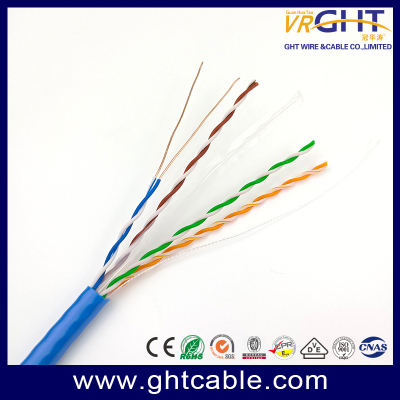
Cat6 remains a popular baseline for standard networks. Supporting a bandwidth of 250 MHz, it comfortably transmits Gigabit Ethernet (1Gbps) over a full 100-meter channel. While Cat6 can handle 10-Gigabit speeds, it is heavily distance-limited, dropping off around 37 to 55 meters depending on crosstalk interference.
Cat6a: The Enterprise Standard for True 10-Gigabit Performance
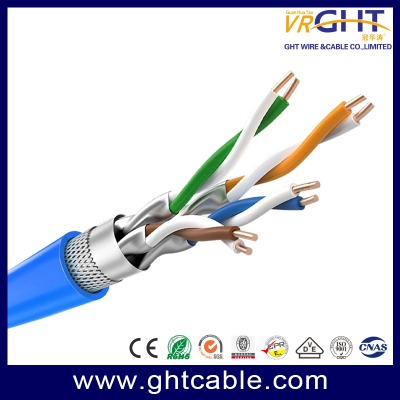
Cat6a (Augmented Category 6) doubles the bandwidth threshold of standard Cat6 to 500 MHz. More importantly, it guarantees true 10-Gigabit Ethernet (10GBASE-T) speeds across a full 100-meter distance. Available in both unshielded and shielded configurations—such as Indoor SFTP Cat6a cables—Cat6a effectively mitigates Alien Crosstalk (ANEXT), making it the go-to solution for modern enterprise environments.
Cat7: Advanced Shielding for High-Noise Environments
Cat7 (Class F) steps up frequency performance to 600 MHz and features individually shielded pairs wrapped in an overall metallic braid (S/FTP). This robust construction minimizes Electromagnetic Interference (EMI). While IEEE standardizes up to 10G for traditional RJ45 configurations, structured cabling approaches utilizing Cat7 are tailored for specialized industrial setups and heavy-duty data environments requiring supreme signal integrity.
Real-World Performance & Practical Selection
Choosing the correct cable goes beyond looking at theoretical numbers on a spec sheet. Real-world conditions often dictate how a network performs.
Minimizing Interference and Crosstalk
In environments densely populated with electrical wiring, fluorescent lighting, or heavy machinery, unshielded cables can suffer from packet loss and degraded signal quality. Upgrading to shielded solutions, such as an Indoor S/FTP Cat6a network cable or Cat7, protects data integrity from external electromagnetic noise.
Balancing Budget and Future-Proofing
- For Homes and Small Offices: Standard Cat6 usually suffices for streaming, gaming, and routine office workloads.
- For Growing Enterprises and Smart Buildings: Cat6a provides an ideal balance of future-proofing, full 10G distance capabilities, and standard RJ45 ecosystem compatibility.
- For Industrial or High-Interference Zones: Heavily shielded options provide the physical resilience required to keep mission-critical operations running smoothly.
Conclusion
Maximizing network performance relies on sourcing high-grade cabling and hardware built to rigorous international standards. Connect with our team today to explore factory-direct network cables, professional network cabinets, and custom solutions tailored to your next infrastructure build.


Leave a comment